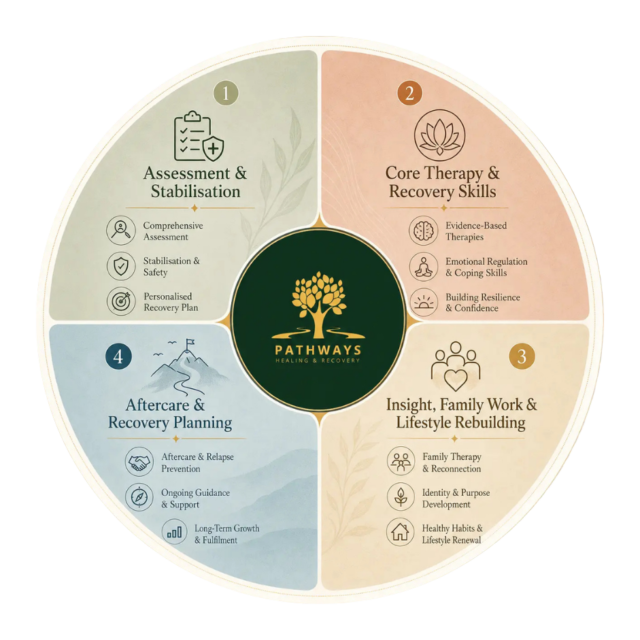


The first week focuses on safety, diagnostic clarity, and settling the client into a structured recovery environment. This may include psychiatric assessment, medication review, substance-use history, withdrawal-risk assessment, mental state examination, sleep evaluation, nutritional review, family input, and screening for dual diagnosis conditions such as depression, anxiety, trauma, bipolar disorder, ADHD, or personality-related difficulties. Where needed, clients may begin withdrawal support, medication-assisted symptom management, sleep stabilisation, customised meals, hydration support, and gentle wellness routines. By the end of this phase, an individualised treatment plan is developed.
Once the client is more stable, the focus shifts toward active therapeutic work. Treatment may include individual psychotherapy, addiction counselling, CBT for identifying triggers and distorted thinking patterns, DBT-based skills for emotional regulation and distress tolerance, motivational interviewing to strengthen commitment to change, relapse prevention planning, craving management, psychoeducation, and trauma-informed therapy where appropriate. Clients also begin building healthier daily routines through structured meals, sleep support, light movement, mindfulness, journaling, and therapeutic group or workshop participation.


As therapy deepens, clients begin exploring the emotional, relational, behavioural, and lifestyle patterns that have sustained addiction or relapse. This phase may include family sessions, communication and boundary work, relapse-pattern analysis, stress-management training, values clarification, spiritual reflection where appropriate, and practical life-planning. Nutrition, physical activity, sleep hygiene, and wellness routines are further strengthened so that recovery is supported biologically, psychologically, socially, and spiritually.
Before discharge, the clinical team reviews progress, diagnosis, medication needs, relapse risks, family concerns, lifestyle changes, and continuing-care requirements. A personalised aftercare plan may include outpatient psychiatric follow-up, individual therapy, family work, relapse prevention reviews, medication management, nutrition guidance, wellness routines, support groups, and crisis-prevention planning. The aim is for the client and family to leave with clarity, confidence, and a realistic plan for maintaining recovery beyond Pathways.


At Pathways, transformational recovery is not a fixed package or standard rehab routine.
Because we work with a small number of clients at a time, treatment can be highly individualised. Each client’s care is shaped around their clinical needs, personal history, family context, physical health, nutrition, emotional wellbeing, and long-term goals.
Our approach is psychiatrist-led, therapy-focused, family-aware, nutrition-supported, and designed to help clients rebuild a life that feels stable, meaningful, and worth protecting.
Recovery is not a destination.
It is a process of growth, discovery, and transformation.
The Pathways Recovery Model is designed to support individuals through that journey—one step, one day, and one meaningful change at a time.