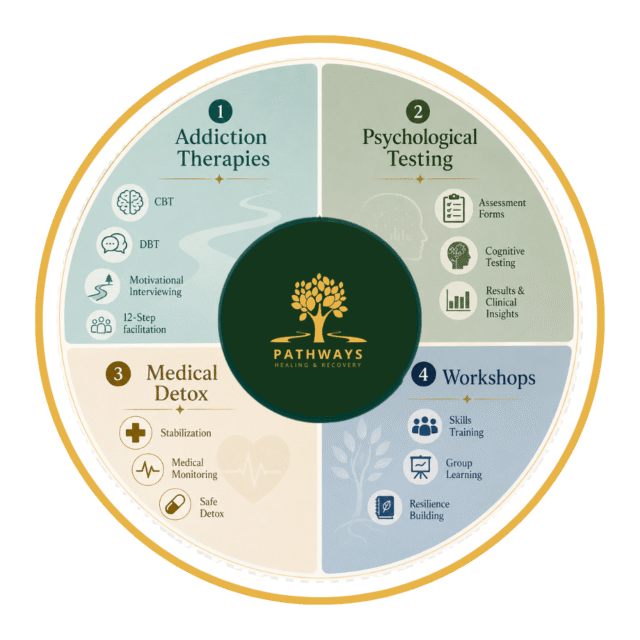


Helps clients identify and modify unhelpful thought patterns, emotional triggers, and behaviours that contribute to addiction, anxiety, depression, and relapse.
Particularly effective for emotional dysregulation, impulsivity, self-destructive behaviours, trauma, and co-occurring personality difficulties. Clients learn mindfulness, distress tolerance, emotional regulation, and interpersonal effectiveness skills.
A collaborative, client-centred approach that helps individuals strengthen motivation and commitment toward positive behavioural change.
Focuses on identifying high-risk situations, cravings, warning signs, and developing practical strategies for maintaining long-term recovery.
Recognizes the impact of adverse life experiences and unresolved trauma that often underlie addiction and mental health challenges.
Helps individuals develop psychological flexibility, reduce experiential avoidance, and build a values-driven life beyond addiction.
Addresses family dynamics, communication patterns, boundaries, enabling behaviours, and relationship repair to support sustainable recovery.
Introduces clients to the principles and practices of the internationally recognized Twelve-Step Recovery Model while encouraging accountability, peer support, and long-term recovery engagement.
Comprehensive assessment allows us to understand the factors contributing to emotional distress, addiction, behavioural difficulties, and impaired functioning.
Our psychological testing services provide objective clinical data that supports accurate diagnosis, treatment planning, and progress monitoring.
Used to evaluate personality structure, coping styles, emotional functioning, interpersonal patterns, and behavioural tendencies.
Examples include:
Evaluates:
Comprehensive evaluation for:
Measures severity and impact of:
Evaluates:
✓ Improved diagnostic accuracy
✓ Individualized treatment planning
✓ Better medication decisions
✓ Identification of underlying issues
✓ Objective measurement of progress


Detoxification is often the first step in recovery. For many individuals, withdrawal can be physically uncomfortable and, in some cases, medically dangerous without appropriate supervision.
Our medically supervised detox programme provides a safe, structured, and compassionate environment where clients can stabilize physically while preparing for ongoing treatment.
A detailed evaluation of physical health, psychiatric status, substance use history, and withdrawal risk.
Regular assessment of symptoms, vital signs, hydration, sleep, and overall wellbeing throughout the detoxification process.
Evidence-based medications may be utilized when clinically indicated to reduce discomfort, minimize complications, and improve safety.
Assessment and management of co-occurring mental health conditions such as depression, anxiety, trauma, bipolar disorder, and psychosis.
Development of an individualized treatment pathway following stabilization.
Healing involves more than symptom reduction. Sustainable recovery requires practical life skills, emotional awareness, resilience, and meaningful personal growth.
Our intensive workshops complement individual therapy by providing structured educational and experiential learning opportunities.
Explores the neuroscience of addiction, relapse mechanisms, recovery stages, and long-term healing.
Based on DBT principles, teaching clients how to manage overwhelming emotions without relying on substances or unhealthy coping strategies.
Practical tools for managing stress, preventing emotional exhaustion, and maintaining psychological wellbeing.
Understanding the effects of trauma while developing healthier coping strategies and emotional resilience.
Evidence-based mindfulness practices that improve emotional regulation, focus, and psychological flexibility.
Building healthier interpersonal relationships through improved communication, boundary-setting, and conflict resolution.
Identifying personal triggers, warning signs, and developing individualized recovery protection strategies.
Helping clients reconnect with personal values, goals, identity, and a meaningful future beyond addiction.


Our approach integrates psychiatry, psychology, addiction medicine, and holistic wellness into one coordinated treatment experience. Rather than focusing solely on symptoms, we help clients understand the deeper biological, psychological, and social factors influencing their wellbeing—creating a foundation for meaningful and lasting recovery.
Recovery is not a destination.
It is a process of growth, discovery, and transformation.
The Pathways Recovery Model is designed to support individuals through that journey—one step, one day, and one meaningful change at a time.